January 2026 changed Altadena. The Eaton Fire moved through the community in a way that most people who were not there are still processing from a distance. Homes that families had lived in for decades were gone in hours. The scale of it is still hard to fully absorb.
We have rebuild projects actively underway in Altadena right now. We are documenting the process because we think it matters to show what it actually takes to bring a home back after something like this -- the practical reality of a fire rebuild: what happens, in what order, how long it takes, and what decisions homeowners face at each stage.
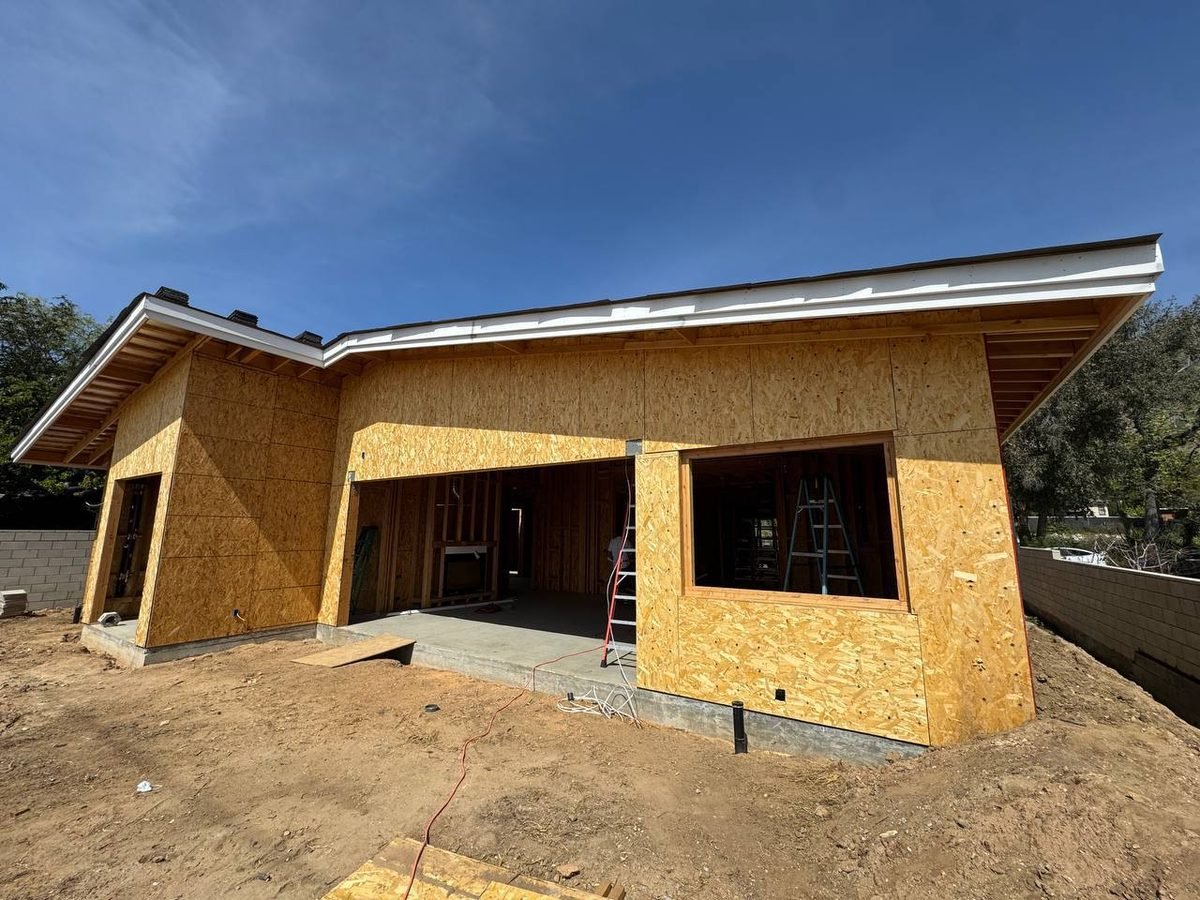
This is the first post in a series that will run all the way through to the reveal. As of today, framing is complete and the exterior sheathing is on. The structure exists. The house has walls and a roofline again. That is a meaningful milestone, and it is a good place to begin.
Where We Started
Fire rebuilds are not like standard remodels or even like new builds on vacant lots. The process begins with a property that has been cleared of debris and declared safe to work on by the relevant agencies, but that process takes time, involves coordination with multiple government entities, and cannot be rushed. Families often spend weeks or months in a state of waiting that has nothing to do with contractor availability and everything to do with the permitting and environmental clearance process that has to happen before a shovel can legally touch the ground.
Once we were cleared to start, we moved through the permit process as efficiently as possible. For a full rebuild in LA County, you are working with building and safety, planning, and utilities, and the coordination between those entities requires a contractor who has done this before and knows how to keep the different tracks moving in parallel rather than waiting for each one to finish before starting the next.
Design decisions on a rebuild are also different from a standard new home project. In a typical new build, the homeowner starts from a blank slate with time to consider every option. In a rebuild after a fire, families are often making major design and materials decisions while still processing loss, still living in temporary housing, still dealing with insurance claims, and still emotionally raw. We approach those conversations carefully. Our job is to make the technical side of the process as clear and low-friction as possible so homeowners can focus on the decisions that actually matter.
Framing: The House Exists Again
Framing is the phase where something invisible becomes visible. You go from a cleared lot to a structure you can walk through, stand inside, and begin to understand as a place. The rooms are there. The ceiling heights are there. The entry, the hallway, the bedroom suite, the kitchen wall, the place where the back door will be, all of it is suddenly physical.
On this project, the design includes a grand entry corridor that will eventually have an oversized wooden front door, and a bedroom suite with a full glass wall. During framing, those features show up as particularly precise structural work: the steel framing for the oversized entry opening, the header dimensions, the shear wall placement. These are the details that make a home feel designed rather than just built, and they have to be framed correctly before anything else can follow.
Exterior sheathing went on after framing was complete. This is OSB or structural panel applied to the framed exterior walls, which does several things simultaneously: it stiffens the structure, provides the nailing surface for the weather-resistive barrier and cladding that comes next, and closes the building envelope against the elements. Once sheathing is on, the job site changes. The interior is protected. Work can happen in all weather conditions, and the next phases of rough-in can begin.
On fire rebuilds in California: Insurance companies have specific requirements for documentation at each phase of construction, and some policies require the GC to coordinate directly with the adjuster at certain milestones. We manage that relationship on behalf of our clients so the documentation is always in order and the homeowner is not caught between their contractor and their insurance company trying to reconcile conflicting requirements.
What Rough-In Looks Like From Here
With framing and sheathing done, the project moves into rough-in: the phase where all the systems that will eventually be hidden inside the walls get installed. Plumbing, electrical, HVAC, fire suppression, low-voltage wiring for data and AV. Every one of these trades has to coordinate with the others because they are all sharing the same wall cavities, the same ceiling planes, the same structural penetrations.
The coordination burden in rough-in is significant, and it is one of the most important things a GC does. A plumber who runs a pipe through a location that was going to carry a structural duct has created a problem that has to be solved in the field, under time pressure, and often at cost. We work through a rough-in coordination review before any trade starts cutting and running, so those conflicts get resolved on paper before they happen in the wall.
On a project with the scope of this one, the rough-in phase also includes some unusual elements. This home has a fire suppression system, which is now required on new construction in many California jurisdictions. Coordinating fire suppression rough-in with the plumbing and HVAC rough-ins requires careful sequencing. The suppression system has its own inspection requirements, and it cannot be buried in the wall until it has been tested and approved.
The Backyard: Engineering, Not an Afterthought
One detail on this project that is worth calling out specifically: the backyard elevation sits lower than the finished floor of the house. In a typical new construction project, that relationship between house and yard is designed early and accommodated in the grading plan. On a rebuild on an existing lot, you are working with the existing topography, which may not be what you would have designed from scratch.
On this lot, we designed a perforated drain system that manages rainwater and surface runoff without requiring a sump pump. The system works by grade and gravity, which means it is passive, requires no mechanical components to maintain, and will not fail during a storm because of a pump outage. This is exactly the kind of detail that does not show up in a marketing brochure but makes a real difference in how a home functions over the 30 or 40 years its owners live in it.
Main Water and Fire Suppression Lines
Main water service and the fire suppression lines are among the last rough-in milestones before the building is ready to close in. Water service has to be sized correctly for the new structure, accounting for the fire suppression system's flow requirements in addition to domestic demand. On a rebuild, you also have to coordinate with the water utility, since the original service line may need to be upgraded if the new home has different requirements than the structure that was there before.
Getting these connections coordinated and inspected before the walls close is not optional. Every licensed contractor knows this, but it is worth saying clearly for homeowners who are navigating this process for the first time: there is no shortcut in rough-in that does not become a much larger problem later. The inspections exist because the work they verify cannot be undone once it is buried.
What Comes Next
From here, the sequence is:
- Rough-in inspections and sign-off (plumbing, electrical, HVAC, fire suppression)
- Insulation installation
- Drywall begins — the phase where the house starts to look like a finished home for the first time
- Finishes: flooring, tile, cabinetry, fixtures
- Final inspections and certificate of occupancy
- The reveal
We will document each of those phases here. The drywall phase is when a project visually transforms, and the reveal post for a fire rebuild carries a weight that a standard remodel reveal does not. We are a long way from that day right now, but it is the day we are working toward.
If you are an Altadena homeowner dealing with a fire rebuild and trying to understand the process, we are happy to answer questions honestly. The process is complicated and the timeline can feel impossibly long from the outside. But the work is moving, and families are getting their homes back. That is what this series is about.
For more on what a major ground-up rebuild or large-scale renovation involves from a planning standpoint, see our guide on 10 things every SGV homeowner should know before starting a remodel. And if you want to understand what permitting actually looks like on a project of this scale, the Las Flores new build series covers that process in detail.
More from this project coming as each phase clears.
繁體中文摘要 — 重建家園:阿爾塔迪納火災後重建進行中
2026年1月的伊頓山火改變了阿爾塔迪納(Altadena)社區。許多家庭在一夜之間失去了住了幾十年的房子。我們受一戶受災家庭委託,為他們全程負責重建工作,從申請許可證到最後交屋,全程跟進。
目前進度:結構木工框架已完成,外牆覆面板(sheathing)也已安裝完畢。這是一個重要的里程碑,代表房子的外形輪廓已經重新出現在這塊地上。
火災重建與普通翻修有何不同?火災重建的程序比一般新建工程更加複雜。施工前需要先通過政府部門的碎片清除和環境安全認定,然後才能申請建築許可。整個過程涉及洛杉磯縣建築安全局、規劃局和市政管線公司的多方協調,缺一不可。我們替屋主管理這些流程,讓他們不必在保險公司和承包商之間來回奔波。
木框架與外牆覆面:框架完成後,你才能真正「走進」房子,感受到空間的格局、天花高度、入口走廊和臥室套間的位置。這個項目設計了一個寬敞的入口走廊,配合特大尺寸木門,以及一整面玻璃牆的臥室套間。外牆結構板的安裝讓建築物開始防水、防風,為下一步的內部粗裝修工程做好準備。
後院排水設計:這個地塊的後院地勢比室內地板低,我們為此設計了一套滲水排水系統,靠坡度和重力自然排水,無需水泵,維護成本低,下雨天也不會因為機械故障而積水。這類細節不會出現在宣傳冊上,但對一個要住幾十年的家來說非常重要。
接下來的工程:粗裝修驗收(水電、暖通、消防噴淋)→ 隔熱材料安裝 → 石膏板(乾牆)→ 地板、瓷磚、廚衛裝修 → 最終驗收拿到入住許可 → 交屋。我們會持續記錄每個階段,請持續關注。
如果您或您認識的家庭正面臨火災後重建的困難,歡迎致電咨詢,我們會如實告知流程和時間安排:(626) 244-6104。我們提供中英雙語服務。
Facing a Fire Rebuild or Major Reconstruction in the SGV?
We handle full ground-up rebuilds, from permits and site work through framing, rough-in, finishes, and final inspection. Owner on every project. Serving Arcadia, Altadena, Pasadena, and the wider San Gabriel Valley. Call (626) 244-6104 or get a free estimate online. CSLB #1150423.