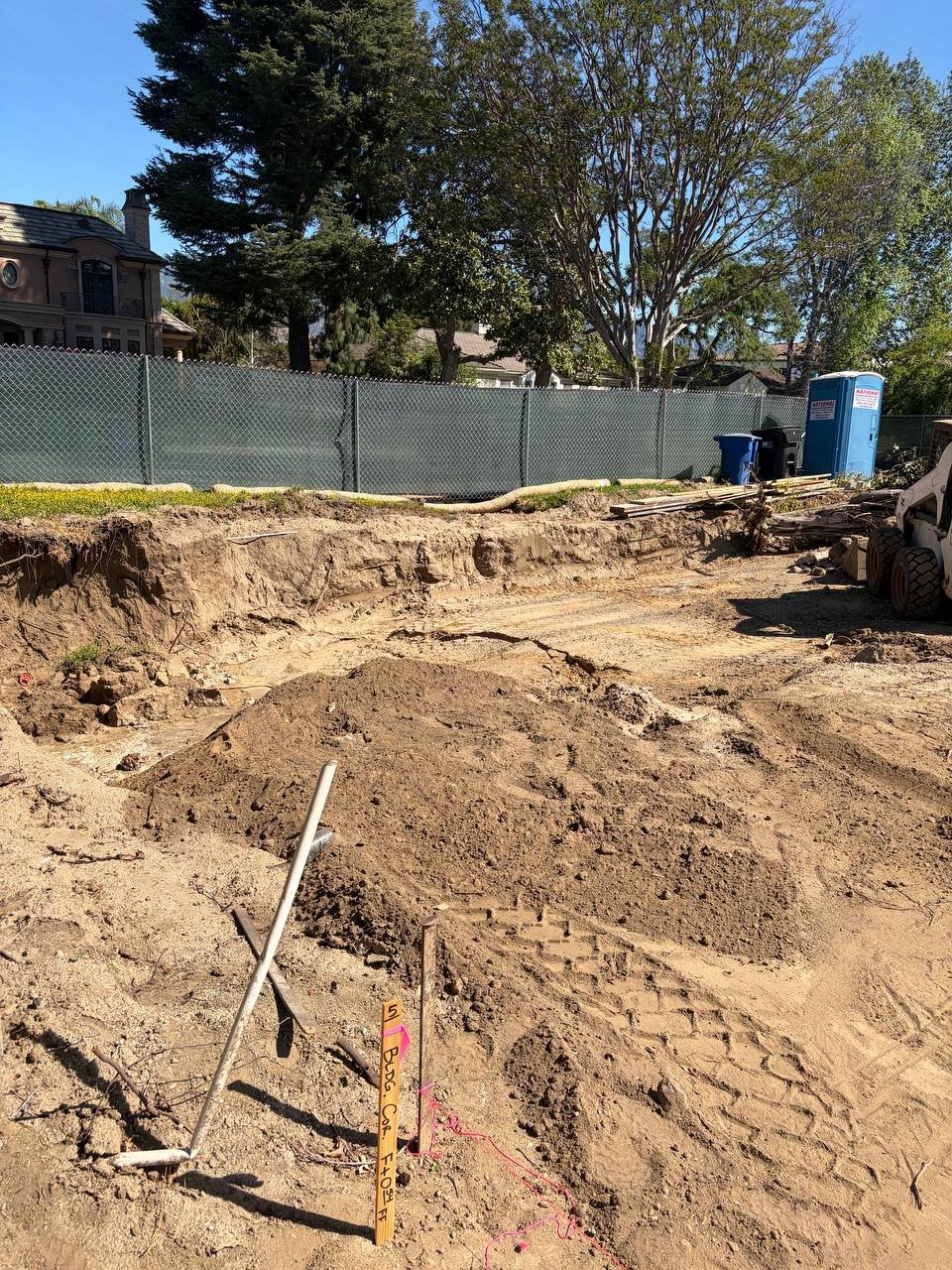
The lot has been cleared. The old pool is gone. Now the real work starts.
We are doing a full ground-up new build in Arcadia right now. The project is a complete tear-down and rebuild on a residential lot that has been cleared and prepped for new construction. This is the second post in an ongoing series documenting the process from start to finish. In the first post we covered the demo and site clearing. Today we are at the point where the survey stakes are in and excavation is actively underway.
That pile of raw dirt in the photo is not a complication. It is progress. Here is what is actually happening.
What Survey Stakes Are and Why They Matter
Before anything gets built, a licensed land surveyor locates the legal property boundaries and sets physical markers in the ground. On a new construction project, those markers tell every trade exactly where the building footprint sits on the lot. Get this wrong and you could be building over a setback line, encroaching on a neighbor's property, or creating a legal problem that stops the project cold months down the road.
The pink flagging tape you see in the photo is attached to a hub stake that has been set to mark a building corner. The notation on the stake references an elevation point that the concrete sub and framing crew will both reference throughout the foundation and framing phases. These small sticks in the dirt are the physical representation of everything in the approved architectural plans. They are the bridge between paper and real life.
A good general contractor does not rush past this step. We confirm the survey is correct, that the setbacks are what they should be, and that the building envelope aligns with what the city approved. On a project this size, a mistake here is not a minor correction. It is a major rework. We check it before a shovel moves significant dirt.
The Excavation Phase
Once the stakes are set, excavation begins. On this project you can see the skid steer working the site -- cutting down to the required depth for the foundation and clearing the material out. What you are looking at in the photo is a lot that has been cut several feet below finish grade, with cut banks on the left side of the frame showing the depth of the dig.
A few things are happening at once during this phase:
- The site is being graded to establish a flat, level working surface for the foundation crew
- Excess soil is being removed from the lot and hauled off
- The machinery is also clearing any leftover root systems or debris from the demo phase
- The form lumber you see stacked near the back fence is being staged for the next phase: building out the footing forms
In the background you can see the neighboring homes clearly. On a residential lot in Arcadia, the proximity of existing structures is a constant consideration. Grading work that is not carefully managed can affect drainage on adjacent properties. We pay attention to this throughout the site work phase.
What We Found Underground
Any contractor who tells you a project will go exactly as planned from day one has not done many projects. What you find underground is always a variable. On this particular site, the utility locations and sewer depth have been factors we've had to work with. We will document that in more detail in an upcoming post when we get to the drainage and sewer sections.
The general principle: the more investigation you do before you pour concrete, the fewer surprises you have afterward. Underground work that has to be modified after a slab is down is expensive and disruptive. Doing it right the first time, in the right sequence, is how you keep a project on schedule and on budget.
For homeowners planning a new build: The site work phase often moves faster than people expect visually, but it is where a lot of critical decisions get made. Foundation depth, drainage routing, utility connections -- these things get locked in during excavation. Your GC should be on site regularly during this phase, not just checking in once a week.
What Comes Next on This Project
After excavation is complete, the sequence moves into:
- Footing forms: The wood forms that define the shape of the concrete foundation go up first
- Rebar placement: Steel reinforcement is tied and placed inside the forms before concrete is poured
- Inspections: The city inspects the foundation before any concrete is poured -- this is a required hold point
- Concrete pour: The foundation is poured in sections, with careful attention to curing conditions and timing
- Framing: Once the foundation has cured to spec, the framing crew can begin vertical work
We are documenting all of it. Follow along on Instagram and TikTok for more frequent updates from the job site.
New Construction in Arcadia and the SGV
Ground-up new builds are a different kind of project from remodels. The complexity is higher, the permit process involves more agencies, and the coordination required between trades is more intensive. We do this work in Arcadia and throughout the San Gabriel Valley -- it is a significant part of what we do as a full-service general contractor.
If you are thinking about a new build in the SGV, the conversation to have with a GC early is about what the permit and entitlement process looks like for your specific lot. Zoning, setbacks, FAR limits, height restrictions -- these all vary by city and sometimes by zone within a city. We have done this in Arcadia, Temple City, San Marino, and other SGV cities. The details matter, and they differ.
Give us a call if you want to talk through a project. We do not charge for the first conversation.
Planning a new build or major project in Arcadia or the SGV?
Call us at (626) 244-6104 or visit our contact page. We are a licensed general contractor (CSLB #1150423) serving Arcadia, Pasadena, Temple City, San Marino, and surrounding SGV cities.
中文摘要
這篇文章記錄了我們目前在阿凱迪亞(Arcadia)進行的一個全新建案的最新進度。
舊建築和泳池已經拆除清理完畢,現在測量樁已經打入地面,挖土工程也正式展開。在開始任何建設之前,持牌測量師必須先確認地界和建築位置,將這些標記牢牢定位在地面上。這一步非常重要,關係到整個建案是否符合建築規範和法規要求。
挖土階段完成後,接下來的步驟包括:搭建基礎模板、放置鋼筋、通過市政府驗收檢查,然後才能澆注混凝土基礎。每一步都有嚴格的順序,不能跳過。
我們會繼續記錄整個建案的進展,從挖土到封頂,一直到最後的完工驗收。
如果您正在考慮在阿凱迪亞或整個聖蓋博谷地區建造新房,歡迎致電洽詢:(626) 244-6104
我們提供中英雙語服務。