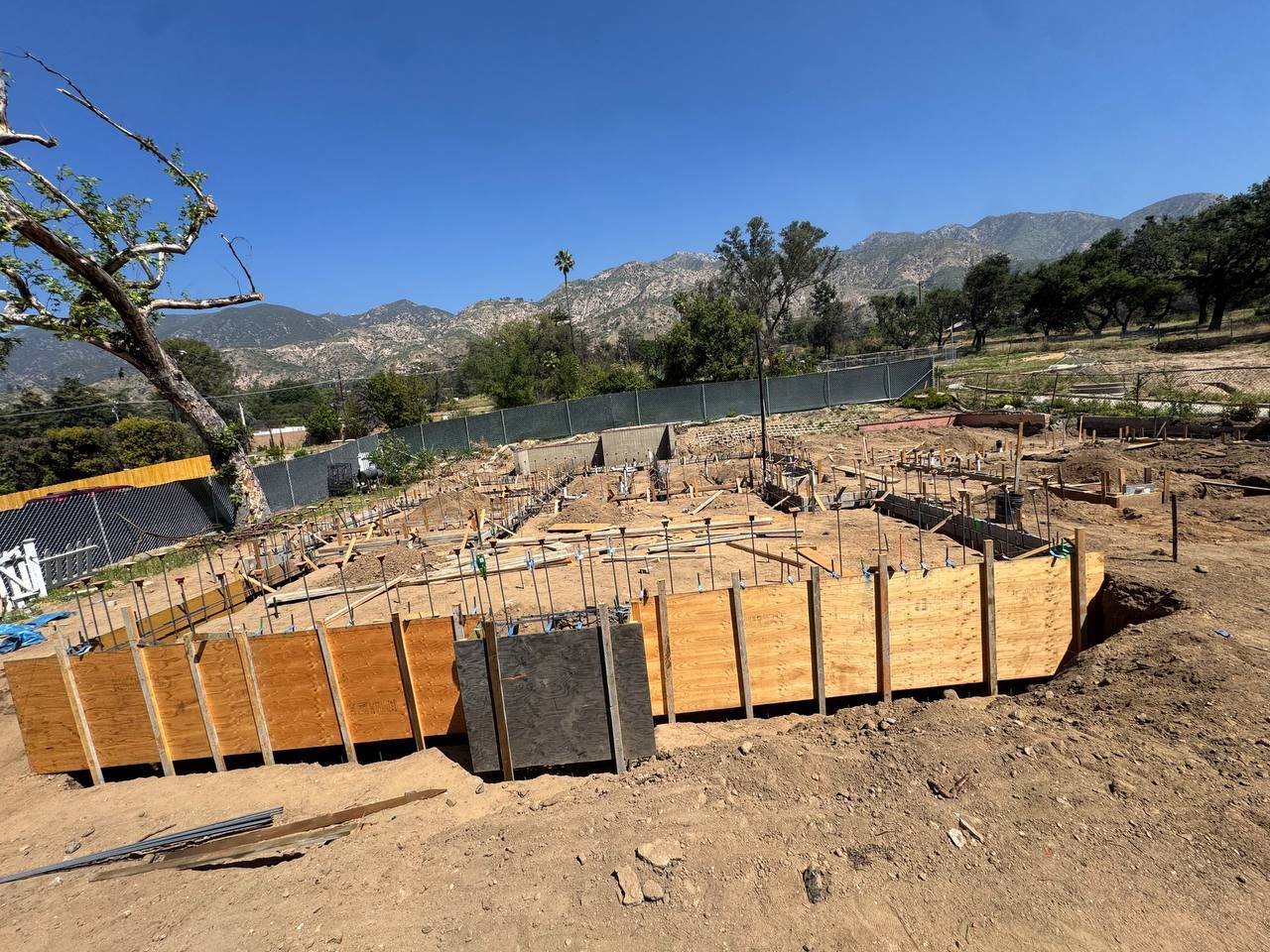
Most people will never see what we documented this week on an Altadena fire rebuild job. Not because it is hidden -- but because once the concrete truck backs in and the pour starts, everything in these photos disappears under three to four inches of slab. It will be there forever, holding up the house, completely invisible.
That is exactly why we think it is worth documenting.
The Phase Between Demo and Pour
After a fire destroy a home down to the foundation, the rebuild does not start with framing. It does not start with concrete. It starts underground -- with the systems that have to be buried before anything else can happen.
On this Altadena project, that meant trenching for the main sewer and drain lines, setting the pipe at the correct depth and slope, surrounding it with the right gravel bed, and making sure every connection was correctly placed for the bathrooms, kitchen, and laundry locations that will eventually be above it. Once the underground plumbing was set, the rebar grid went in -- laid to spec, tied at every intersection, held at the correct height off the ground with chairs so the concrete can flow underneath and fully encapsulate the steel.
Then the forms went up around the perimeter. The forms define the edge of the slab and hold the concrete in place while it cures. They have to be level. They have to be square. Any error here shows up in every wall that gets framed on top of it.
Why the Inspection Matters
Before any concrete can be ordered, the county inspector has to sign off on the underground work. They check the pipe depth, the slope, the rebar spacing, the form placement, and the overall layout against the approved plans. There is no skipping this step, and there is no fixing it after the pour.
On permitted work in Los Angeles County, a foundation inspection is required before the concrete pour. This is not optional -- it is the law, and it protects the homeowner. If a contractor pours without an inspection, they are creating a liability that will surface at every future sale, refinance, or permit pull.
We do not pour until the inspector has walked the site and signed the card. Every time. This adds a day or two to the schedule, but it is not something we negotiate around.
What We Are Looking At on This Job
The underground drains are in and complete. The rebar is set. The forms are up. Inspection is scheduled and we expect the pour to happen within the next few days.
When you look at the photo at the top of this post, you are looking at a job site that is about 48 to 72 hours away from a major milestone. The San Gabriel Mountains are in the background. The wood forms and rebar grid are in the foreground. In a few days, that whole center section will be covered in four inches of concrete and the framing crew will start setting plates on top of it.
That is how a rebuild moves from a cleared lot to a standing structure. One phase at a time, in the right order, with inspections in between.
The Difference Between a Rebuild and a Standard Remodel
On a typical kitchen or bathroom remodel, you are working within an existing structure. The foundation is already there. The plumbing is already roughed in somewhere. You are modifying, replacing, and updating.
On a full fire rebuild, you are starting from nothing. The foundation either needs to be repaired or poured fresh. The underground systems are gone. Every inch of pipe, wire, and concrete has to be installed new, in the right sequence, with the right inspections.
This is why fire rebuilds take the time they take. Not because contractors are slow -- but because the process has a defined order, and you cannot compress the steps without cutting corners that will cost the homeowner later.
What Comes Next
After the pour and the cure -- typically five to seven days before the slab reaches enough strength to work on -- the framing starts. Pressure-treated plates go down on the slab, walls get built, and the house starts to take shape above ground for the first time since the fire.
We will keep documenting as this project moves forward. If you have questions about the fire rebuild process in Altadena, or if you are a homeowner working through your own rebuild and want to understand the timeline and sequence, give us a call. We are happy to talk through it.
Questions About Fire Rebuilds in the SGV?
We are working on multiple Altadena fire rebuild projects. If you want to understand the process, timeline, or what to expect from your GC -- call us at (626) 244-6104 or visit brickbybrick626.com/contact. Licensed, bonded, CSLB #1150423.
中文摘要 — 奧特迪納火災重建:澆築混凝土前的地基工程
這篇文章記錄了我們在奧特迪納(Altadena)火災重建項目中的地基工程進度。在混凝土澆築之前,所有地下排水管道、鋼筋網和模板都必須按照規範安裝完畢,並通過洛杉磯縣的現場檢查,才能進行下一步。
這個施工步驟非常關鍵:一旦混凝土澆下去,地下所有管道和鋼筋就永遠看不到了。做對了,房子的基礎就是紮實的;做錯了,以後的問題難以修復。
我們在每個項目上都嚴格按照許可證和檢查流程施工,不走捷徑。目前地下排水管道已完成,鋼筋和模板就位,等待檢查官驗收,預計數天內即可澆築地板。
如果您也在考慮火災重建或有任何裝修問題,歡迎致電 (626) 244-6104。我們提供中英雙語服務。