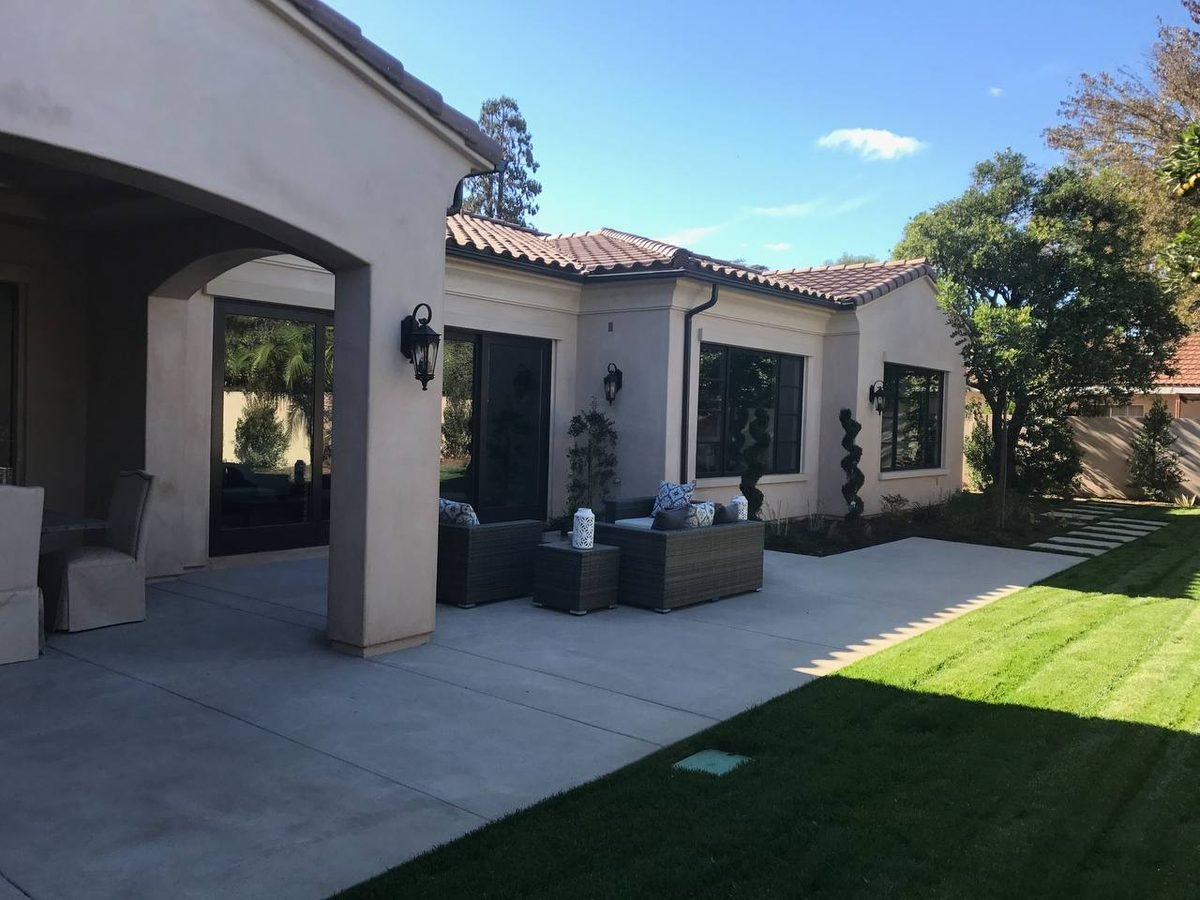
People ask me about decking materials more than almost any other single question. It comes up on every home addition project and on plenty of standalone deck builds throughout Arcadia, Pasadena, and the broader SGV. Here’s what I actually tell people, without the lumber yard sales pitch.
Why California’s Climate Is Different From the Rest of the Country
Most decking advice you find online is written for the Pacific Northwest, the Southeast, or the Midwest. Those climates feature real humidity, real cold winters, or both. The SGV is different. Here’s what our climate actually does to wood:
- UV exposure is intense. At our latitude and elevation, with clear skies most of the year, direct sun breaks down wood fibers and finishes faster than in cloudier climates. Untreated softwoods can gray out within a single dry season.
- Dry cycles cause movement. When wood loses moisture in a long dry summer, it shrinks and gaps open between boards. When winter rains return, it swells. This repeated movement accelerates splitting and fastener loosening.
- Rot risk is moderate, not high. Unlike coastal or rain-heavy climates, most SGV homes don’t face the relentless moisture that destroys untreated wood quickly. But shaded areas, planters built against the deck, and irrigated yards create pockets of sustained moisture that still cause problems over time.
- Insects matter. Termites are a real issue in LA County, including Arcadia. Wood selection and proper installation (keeping wood off direct soil contact, maintaining airflow under the deck) matter for long-term pest resistance.
With that context in mind, here’s how the main decking options actually perform.
Redwood: The California Native
If you’re building a wood deck in California, redwood deserves the first look. It’s not nostalgia. There are practical reasons it has been the dominant deck wood here for a century.
What makes it good: Redwood contains natural tannins and oils that resist rot, insects, and moisture absorption without chemical treatment. It’s dimensionally stable, meaning it moves less through wet/dry cycles than most softwoods. It takes stain and sealant beautifully and the heartwood is naturally durable enough to hold up with minimal maintenance.
Grades to know: “All heart” redwood is the tight-grained, reddish heartwood with the best natural durability. “Construction heart” is more affordable and still performs well. Avoid sapwood-heavy grades for decking -- the pale, cream-colored sapwood doesn’t have the same rot resistance as heartwood.
Realistic lifespan: 25 to 30 years with basic maintenance (annual cleaning, every few years of sealant). Neglected redwood decks still commonly outlast untreated pine by a decade or more.
Cost: Redwood has gotten expensive. Expect $5 to $9 per linear foot for quality decking boards, depending on grade and board width. For a 400 sq. ft. deck, lumber alone might run $3,500 to $5,500 before installation.
Sustainability: Demand FSC-certified redwood. California’s old-growth forests should not be harvested for decking. Certified second-growth redwood is a genuinely sustainable option and performs identically in practice.
SGV Tip: In Arcadia and most of the SGV, redwood decking should always have a minimum 6-inch clearance from grade. We have subterranean termites throughout LA County. Good airflow under the deck and wood-to-soil separation are not optional considerations on a well-built deck.
Western Red Cedar: The Practical Alternative
Cedar is the runner-up that deserves more credit. It shares many of redwood’s best properties at a price point that’s typically 20 to 35 percent lower.
Natural oils, lighter weight: Western red cedar has natural preservative oils that resist rot and insects. It’s also lighter than redwood, which matters when building a freestanding deck or decking over an existing structure where load is a concern.
Dimensional stability: Cedar is one of the more stable softwoods, handling the SGV’s dry/wet cycles reasonably well. It is more prone to surface checking (small surface cracks) than redwood if left unfinished, so sealing annually is more important here.
Appearance: Fresh cedar has a warm honey-tan color that grays to silver without treatment. Many homeowners like the weathered gray look. Others prefer to maintain the natural color with oil finishes. Both are valid approaches, but you need to commit to one from the start because switching later is a larger project.
Cost: Roughly $3.50 to $6.50 per linear foot for quality cedar decking, depending on grade and sourcing.
Ipe (Brazilian Walnut): The Premium Option
Ipe is the wood that shows up in high-end deck projects, boardwalks, and commercial applications where longevity is the primary concern. It’s worth knowing about even if it’s not the right fit for every budget.
Extreme density and hardness: Ipe is so dense it barely floats. That density translates to a Janka hardness rating of 3,684 lbf -- about five times harder than redwood. Scratches, dents, and surface wear from furniture are essentially non-issues.
Natural Class A fire rating: This matters in California. Ipe is one of the only wood decking materials with a natural Class A fire resistance rating. In areas with defensible space requirements or where fire risk is a planning concern, that’s a meaningful spec.
50-year lifespan: With minimal maintenance -- typically a light annual cleaning and a penetrating oil every couple of years -- well-installed ipe decks routinely last 40 to 75 years. That is a number you don’t see with domestic softwoods.
Installation is specialized: Ipe’s density means it must be pre-drilled for every fastener and requires carbide-tipped blades for cutting. Any contractor you hire needs to have worked with it before. Improper installation with standard tools results in cracked boards and backed-out fasteners.
Cost and sourcing: Ipe typically runs $8 to $14 per linear foot. The sustainability question is real -- verify FSC certification. Reputable importers can provide chain-of-custody documentation. Be skeptical of ipe that is priced significantly below market; legal, certified tropical hardwoods have a cost floor.
Composite Decking: The Low-Maintenance Choice
Composite decking has improved dramatically over the past ten years. The early products from the late 1990s and 2000s had real problems: they faded badly, stained from mildew, and expanded enough in heat to cause warping. Modern capped composites are a different product.
Capped composite vs. uncapped: The difference matters. Uncapped composites are wood fiber mixed with plastic. They still absorb moisture and can stain or mold. Capped composites have a protective polymer shell on all four sides that prevents moisture absorption almost entirely. Always specify capped composite for California outdoor use.
Performance in our climate: Modern composites handle UV better than any natural wood without treatment. They don’t require annual sealing, don’t splinter, and won’t support termites. For a Arcadia or San Marino homeowner who wants an outdoor living space that stays looking clean with a hose-down once a year, composite is worth serious consideration.
What it doesn’t do well: Composite heats up more than wood in direct California sun -- surface temperatures on dark-colored composite boards on a hot day can be uncomfortably hot underfoot. Light colors handle this better. Composite also lacks the natural character and grain of wood, which matters to some homeowners and not at all to others.
Cost: Quality capped composite (Trex Transcend, TimberTech Azek, Fiberon Paramount) runs $7 to $12 per linear foot for decking boards alone. Including the hidden fastener system, trim, and framing, composite decks often cost more upfront than wood but significantly less over a 20-year horizon when maintenance costs are factored in.
Quick Comparison
| Material | Cost (per LF) | Lifespan | Maintenance | Best For |
|---|---|---|---|---|
| Redwood | $5 – $9 | 25 – 30 yr | Moderate | Classic California look, solid value |
| Cedar | $3.50 – $6.50 | 20 – 25 yr | Moderate | Budget-conscious, lighter loads |
| Ipe | $8 – $14 | 40 – 75 yr | Minimal | Long-term investment, fire rating |
| Composite (capped) | $7 – $12 | 25 – 30 yr | Very low | Low maintenance, family-use deck |
Permits: What You Need to Know in Arcadia and the SGV
A deck build in Arcadia requires a building permit when the deck is more than 30 inches above grade or attached to the house. The threshold triggers zoning setbacks, structural review, and inspection requirements. Most of the decks we build fall into this category.
The permit process in Arcadia is manageable. You’ll need a site plan showing the deck location and dimensions, a structural detail for the framing and post footings, and a completed permit application. Turnaround is typically two to four weeks for residential deck permits. I pull these regularly -- it’s not an obstacle, it’s just part of the process.
For neighbors in Pasadena or Monrovia, the process is similar with minor variations in setback requirements and HOA considerations for certain neighborhoods.
Never skip the permit. Unpermitted decks in California create title problems when you sell. Buyers’ agents now routinely pull permit histories. An unpermitted deck can kill a sale, require demolition, or reduce your sale price by more than the deck cost to build. Pull the permit.
The Framing Matters As Much As the Decking
One thing homeowners often miss: the decking boards themselves are only part of the project. The framing -- posts, beams, joists -- carries the load and determines how long the deck lasts structurally. A beautiful redwood surface on a poorly detailed frame will still fail.
For California conditions, framing should use pressure-treated lumber (rated for ground contact where applicable), hot-dipped galvanized or stainless steel hardware throughout, and properly sized footings based on soil conditions and local frost depth (minimal here, but still required by code). Composite or ipe decking does not eliminate the need for quality framing underneath.
For more context on outdoor materials and project planning, the post on SGV weekend projects that add real value covers how outdoor improvements factor into home equity. And if you’re considering a larger project that includes a deck alongside an addition or ADU, see our 2026 ADU guide for Arcadia for how these projects coordinate.
繁體中文摘要 — 加州戶外甲板木材選擇指南
南加州幾乎全年都是戶外活動的好季節,因此甲板建材的選擇尤為重要。聖蓋博谷的氣候特點是強烈紫外線、乾濕交替的季節變化以及白蟻問題,這些都對木材耐久性有直接影響。
紅杉木(Redwood):加州本土木材,天然含有抗腐爛和防蟲的單寧酸,尺寸穩定、適合乾濕氣候交替環境。建議選用FSC認證的二代林紅杉。使用年限約25至30年,每線性英尺約$5至$9。
西部紅雪松(Western Red Cedar):性能接近紅杉木,價格低約20至35%,重量更輕,適合荷重限制較嚴的結構。需要每年上油封以保持色澤,否則會自然變灰。每線性英尺約$3.50至$6.50。
巴西胡桃木(Ipe):極高密度硬木,天然A級防火等級(在加州山火防護區具重要意義),使用年限可達40至75年。安裝前需預先鑽孔,施工技術要求較高。每線性英尺約$8至$14,請確認FSC認證來源。
複合材料甲板(Capped Composite):現代包覆型複合板材已大幅改善舊款缺點,防曬、防白蟻、不需年度上漆。維護成本極低,適合重視便利性的屋主。但深色板材在加州夏日直射下表面溫度較高,建議選淺色系。
許可證提醒:在阿凱迪亞,甲板距離地面超過30英寸或連接房屋時,必須申請建築許可。未申請許可的甲板在房屋出售時可能造成產權問題,請務必合規施工。
如需免費估價或工程諮詢,歡迎致電:(626) 244-6104。我們提供中英雙語服務。
Planning a Deck in Arcadia or the SGV?
We handle deck design, permits, and full construction throughout Arcadia, Pasadena, Monrovia, and the San Gabriel Valley. Free estimate, honest pricing, owner on every project. Call (626) 244-6104 or use our contact form. CSLB #1150423.